
Impact Leaders: Sophie O’Brien on fixing hiring, backing overlooked talent, and building Pollen

For this edition of Impact Leaders, Toby speaks with Sophie O’Brien, founder of Pollen Careers, about what happens when you stop trying to game broken hiring systems and start redesigning them instead. They talk about the frustration that led Sophie to build Pollen, what she has learned from working with early-career talent, how she balances values with commercial reality, and why impact often shows up in the smallest moments as much as the big wins.
Follow Sophie on LinkedIn: https://www.linkedin.com/in/sophie-pollen/
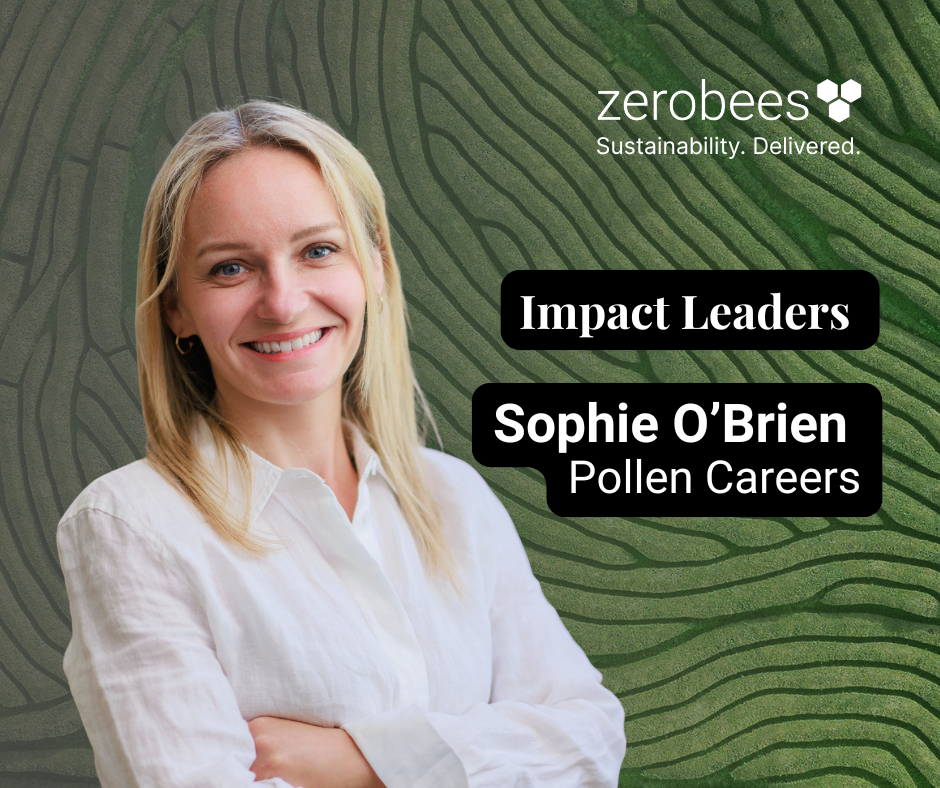
Toby: Sophie, thank you for joining us on Impact Leaders. You've built a really distinctive model around early-career hiring - no CVs, strong community, a clear mission, and a real attempt to make it more human. What was the moment when you stopped thinking, "This is really frustrating," and started thinking, "I can build an alternative to this system?"
Sophie: I think the problem with hiring affects two major audiences: the person on the receiving end and the person applying.
In my last job, I'd ended up doing a lot of recruitment on top of my day job. I was working in a small business, the company was growing, and I was the person who kept putting my hand up and saying, "Yeah, I can do that." At one stage I stormed out of the office in tears, nine months pregnant, because nobody really understood how overwhelming it is to project-manage a recruitment process. Adding one more hire is not a small thing. It is administrative hell.
We were also very values-led. We had this ethos that anyone who came into contact with the business - applicant, supplier, client, whoever - should have a positive experience, because you don't know how you might meet that person again. Karma is a real thing. If you treat people with kindness and respect, that matters.
Then I left that job and started looking for another one. Even with insider knowledge of how recruitment works, I was slinging my CV against a wall. I applied to over 100 roles, rarely heard anything back, and most of the time I was auto-rejected by robots. Easy Apply becomes addictive. You start applying to things you never really wanted, while employers are overwhelmed and forced to make assumptions on very limited information.
What really hit me was this: if somebody like me, who usually backed themselves, could feel that low, how awful must it be for somebody who doesn’t have that confidence, doesn’t have experience, or is already marginalised by the system? Quite possibly brilliant people are being filtered out and chronically overlooked.
I think by about the hundredth application, I just thought: there must be a better way. Off I go.
Toby: I love that your answer to that wasn't just to try different tactics, but to say, "I'm going to fix the system."
Sophie: Yeah, because all the advice out there is like, "How to cheat the system." And I was like, how about if we change the system? You shouldn't need to know a recruiting algorithm in order to get a job.

Toby: Did you immediately imagine Pollen as it is now, or were there steps?
Sophie: I secretly did know what the solution looked like. I started trying to build it with low- and no-code tools, then realised I couldn't get it where I wanted it to go. But I did put up a marketing site saying, essentially, "This is what I think needs to happen."
At first I assumed I'd need investment straight away. But the more I spoke to other founders - especially female founders who'd had horrible investment experiences - the more it felt like the full tech solution maybe wasn't the right first step. So I thought: I'm going to build community, speak to people, and figure out what they actually want.
That changed everything. I started doing interview confidence workshops and talking to people, and the more I did that, the angrier I got, because I kept meeting amazing people and thinking: this is cripplingly unfair. It’s not okay that somebody can apply to 500 jobs and not speak to a human.
So I hired an intern and wrote a job ad saying I wasn't going to look at a single CV. I didn't care about academic background or degrees. I described the kind of person who would thrive, and I made a commitment to give everybody feedback, because I knew how awful it was to throw your CV into a void and hear nothing.
I launched the job and got over 1,000 applications. I asked everybody to complete an assessment, built scoring systems in Google Sheets, and fulfilled that commitment. Slowly, but properly, I gave everybody feedback.
That’s when the floodgates opened. I got all these messages saying, "I can't believe I haven't found this sooner. There is nothing else like this."
Then I tested the process with an ex-colleague who was hiring. He'd already rejected a pile of candidates through LinkedIn Jobs. I asked if I could take that rejected pile through the process we'd designed. The person who got the job was in the rejected pile. That was the moment I really knew I was onto something.
Toby: And where is Pollen now?
Sophie: We've grown the community to around 12,000 people, placed around 150 people into jobs, and we've just launched the platform as a proper one-stop shop. But it's been three years of blood, sweat and tears.
Toby: Did you stay broad intentionally, or were you ever tempted to focus on one sector?
Sophie: People have always told us to niche down into one industry first, because that's the standard startup advice. But I resisted it, because when you're just starting out, most people don't know what they want to do, or all the careers they could actually be brilliant at.
There’s so much pressure when you’re young to think your career should be a neat, linear journey. But that isn’t how real life works, especially now. New roles are emerging all the time. So it was important to stay role- and industry-agnostic, as long as the job doesn’t require very specific prior experience. If somebody can learn it on the job with the right support, the model should work - and so far, it has.
Toby: Talk us through the Pollen model. What does the experience actually look like for a candidate and an employer?
Sophie: For candidates, it starts with signing up to the community platform. That gives them access to events, masterclasses, a Slack channel, a newsletter and mentoring - anything that gets them closer to a human than the normal job hunt does.
Then there’s profile creation, which is a behavioural assessment based on DISC. It gives people a report on their strengths and the kind of roles they might suit. It’s designed to be fun and useful, not some intimidating psychometric test.
When they apply for a job, they don’t upload a CV. They complete a role-specific task designed for that exact role. Then our team reviews it, keeps them updated in the platform, and if it looks like a good match, we put them forward. They always get feedback - scores, personalised notes, a proper end loop. It’s never just silence.
On our side, every assessment has a bespoke scoring model. We can track where people are in the process, and we can also see how candidates from different backgrounds are progressing.
Because we're a B Corp, we exist for more than just recruitment. What we're proving is that if you design a process that is genuinely more inclusive - and stop knocking people out based on arbitrary things like academics or prior experience - you naturally get more diverse shortlists. And often the people who are marginalised by traditional recruitment are actually the best people for the job.
So the case we're making is that redesigning the system doesn't just make hiring faster and better organised. People stay in the job for longer too. There's a commercial case and a social case.
Toby: And you're not trying to take humans out of the process.
Sophie: No. We're not replacing decision-making with AI. We've used technology to speed up our operating system and make human decision-making more objective. There’s so much bias in normal hiring that a more standardised scoring system helps hugely. And even when candidates go to the employer, we ask them to stick to a consistent scoring approach too, so the loop gets closed.
Toby: How do you balance the commercial side with the values side?
Sophie: A lot of that comes down to the employers we work with. We're lucky that most are very values-led - smaller businesses, progressive leaders, often B Corps. That makes it easier to prove the commercial case while protecting the candidate experience, which we're fiercely protective over.
Because this is an ecosystem. If one bad employer ruins the journey for a job seeker, then we can't fulfil our commitment to them. The trust breaks.
That’s also where it gets difficult. We've had employers go through the process and then say, "Oh, but they don't have a degree." In one case, that was a social mobility charity, which really says it all. We've also had employers offering minimum wage for professional roles. We’ve been very firm about that. We won’t work with an employer, and we won’t promote a role, unless it pays the real Living Wage.
In our terms, employers agree to fair hiring standards, to giving feedback, and to being communicative and respectful. We're taking so much pain away from them. We are not flooding them with applications. We are shortlisting brilliant people.
But sometimes they sign off fast because they have an urgent need, and then later the values gap appears. At that point, we've had to say we can't work with you, or we can't work with you again until you sort it out. In some cases that has cost us a lot of money. But we have to stand by our values.
Toby: You became a B Corp at the end of last year. What has that meant for you?
Sophie: Mostly validation. I’ve often felt a bit weird in business settings, because a lot of people seem to start businesses just to make more money, and I’m a bit baffled by that. I’m doing this to fix recruitment. We’re trying to spark a movement.
So for me, B Corp has helped us find our people. When you’re in a room with other B Corps, they instantly get it. It’s been a validation of who we are and what we stand for, but it’s also opened up a really like-minded network.
Toby: And how did you find the process itself as a small business?
Sophie: Long. Eighteen months. And as a small team without dedicated resource, it was just this ongoing thing. At some point I assumed it was never going to happen, so when the email came through I was a bit like, "Oh... really?"
My advice would be: don’t go into it thinking you fill in a form, pay a subscription fee and get the badge. It is rightfully much more rigorous than that. But the opportunity cost is real for a small business. You do find yourself thinking, I could just go and make more money instead. And often that is the easier option.
Toby: What does leadership and culture look like inside Pollen?
Sophie: We're four people, with one of those four on maternity leave. In a small business, one energy in the room that breaks things is catastrophic. So I'm incredibly protective over culture and over valuable people. And even though people think I'm very nice, I'm quite quick to make tough decisions if they need to happen.
A lot of that comes from my own career. I've spent so much of it feeling like an overachiever who put loads of energy into other people's businesses, while people who weren't delivering often got paid more or had more upside just because they shouted louder. I was clear I didn't want to run Pollen like that.
My employees are shareholders as well. I want them to win out of this. This isn’t for personal gain.
It’s emotional work too. Somebody cries at least once a week - sometimes happy tears because somebody gets the job, sometimes frustration, usually because of injustice.
We also work a four-day week because we have to protect energy, mental health and physical health. We're so productive in four days that we honestly don't need to do more. And now, with tools like Claude, it’s actually dangerous how productive you can be. You can make an idea live within an hour. So we have to protect our brains as much as our time.
Toby: What are young people telling you about work that employers still aren't hearing clearly enough?
Sophie: I think there's a massive disconnect and a lot of assumptions on both sides. Flexibility is the obvious one. There's a stereotype that Gen Z all want to work remotely and have huge demands around work-life balance. Honestly, if they've figured out how to put those boundaries in place, fair play.
But our generation is sort of stuck in the middle. We know the old stick approach doesn't work. We also got lured into the carrot version - work harder, climb the ladder, get more money, get promoted. And now we're trying to work out how to bring this next generation into work when maybe they've actually got some better ideas.
The broad-brush assumptions just aren't useful. Some people do want to be in an office five days a week. Some don't. Everybody has different values and wants different things.
And there’s a practical question underneath it too: if junior staff need mentoring, learning by osmosis, and those informal opportunities, how do you make that work if the people who would normally provide that mentorship are working more flexibly? That’s a real workplace question.
Toby: What is one belief about talent that you now hold more strongly than before you started this?
Sophie: Talent is everywhere. You've just got to look for it.
I've always looked at big corporate schemes and thought they segment people in the wrong way - elite graduates here, non-graduates there, seriously disadvantaged there. There’s a scheme for everything, but then there’s no scheme for everybody else. Not everybody fits in a box.
And honestly, I'd argue there often isn't a huge difference in ability between those groups anyway. Some of the best talent is in the group that gets paid the least and appreciated the least. Building this community has completely validated that belief for me. Talent is everywhere, regardless of what box you're in. We need to quit boxing people.

Toby: Finally, what does impact leadership mean to you?
Sophie: On a personal level, impact means changing somebody's life for the better.
And one thing I've really tried to instil in the team is that impact can be tiny as well as transformational. It can be as little as sending someone a quick note when you haven't heard back from an employer yet, just so they know they haven't been forgotten. That creates impact, because somebody feels valued and heard.
Obviously, doing it at scale is the North Star. But sometimes there’s so much pressure to get to the North Star that we forget the little things. And actually, you’re still creating impact in micro doses every single day. Don’t take that for granted. The bigger opportunities will come.

This series of interviews is in support of our mission to accelerate sustainability and decarbonisation across SMEs, NGOs and value chains. By sharing experiences, lessons learned and tips and tricks to embedding sustainability, we can all learn how to improve more, faster.
ZeroBees (certified B Corp) are experts advisors for impact, sustainability and B Corp. From measuring and reducing greenhouse gas emissions to full support for B Corp assessment and re-certification, communication and impact reporting, we're here to help you navigate what's important and how to leverage your strengths. Book a call with us today.
Need support for your sustainability journey?
Get in touch with us at ZeroBees.


Comments